Probably the most important thing in a colony type story is your colonists. After all the colonists are the characters and the characters create the conflict which drives the story. So when you are creating your colonists whether it's too another planet, the moon, or even if you are writing a historical or fantasy and just moving somewhere else on your planet here are some questions to keep in mind.
Who are your colonists? Are they all male? Are they all female? Are they family groups? Are they young? Are they old? Are the ages mixed?
Why are they going? Did they volunteer? Were they forced to leave by their society? Are they persecuted? Are they out for adventure and exploration? Is there something wrong with their homeworld? Did they even know they were going?
Where are they going? How far is it? Do they all want to leave or do some of them want to stay at home? If there are some that don't want to go why are they going? Are they younger people such as teens or preteens and they are forced to go by their parents? Are they going because someone else is going but would never go on their own? Are they starting a new colony or one that is already established?
For example, Kim Stanley Robinson's Mars trilogy he has 100 colonists that are made up of mostly American and Russian scientists with a handful of scientists from other countries. It's a joint effort between Russia and the US to explore Mars and to see how well it would be for colonization. Only the best and the brightest of the scientists were chosen. They are both male and female and on the older side of the age spectrum.
In Monica Hughes young adult book Invitation to the Game the colonists do not have a clue.
In Ray Bradbury's Martian Chronicles there are a few different colonists. One man goes in order to avoid the censors and censorship that have taken over Earth. Another man moves there in order to plant Apple trees. Another moved there with his wife in order to make a lot of money.
In Paula Danzinger's young adult book This Place has No Atmosphere a teenage girl is forced to go with her parents to spend a year on an already established colony on the moon.
As much as I hate outlining and answering questionairres these questions will help you when writing your own colony story. Don't say just because I need it to go this way to work for my story. Give them a real reason. Remember fiction has to be more rational than reality.
Tuesday, June 2, 2009

Thursday, May 21, 2009
I have a plot
After creating 122 characters I finally came up with a plot. It has internal conflict, external conflict that involves overthrowing the existing government power. I knew it would come to me eventually. Although I don't know if you would call this outlining. I'm not much of an outliner and when I do I seem to lose interest in the story.
In order for this story to work I'll only need the 1400 original colonists, the first generation and possibly the second generation. Of course they have by no means reached the new home planet. I smell a sequel and so it might just be a trilogy because they are oh so popular in science fiction and fantasy.
The ever popular question: Do you outline or wing it?
In order for this story to work I'll only need the 1400 original colonists, the first generation and possibly the second generation. Of course they have by no means reached the new home planet. I smell a sequel and so it might just be a trilogy because they are oh so popular in science fiction and fantasy.
The ever popular question: Do you outline or wing it?
Tuesday, May 19, 2009
From the bookshelf - off world colonies
I thought I'd put up a list of novels from my bookshelf that have off Earth colonies. I haven't read for enjoyment for awhile. Being a history major is a lot of reading and writing and leaves little time for reading for fun. After looking and trying to remember what each book is about I found four books that deal with off Earth colonies. I haven't had a chance to read everything I own and while I have a lot of science fiction I didn't realize how few dealt with off world colonies.
Ender's Game series by Orson Scott Card- While Ender's Game doesn't really deal with off world colonies it does open the door to the rest of the series which does deal with off world colonies or rather one off world colony in particular, the planet Lusitania. These three books are set far in the future after Ender's Game and could be read without having reading Ender's Game. They are, Speaker for the Dead, Xenocide, Children of the Mind. Although it is recommended that you read
all four books.
The next set is the Mars trilogy by Kim Stanley Robinson. Red Mars, Green Mars, and Blue Mars. It follows the first 100 colonists to Mars. It has politics, economics, science, culture, and religion. A must read for all people who love Mars.
My first adult novel about an off Earth Colony was Lear's Daughters by M. Bradley Kellog with William Rossow. My dad bought it for me at the public library for a quarter. It deals with humans studying an alien culture so a lot of soft sciences in this one. Sociology, anthropology, the study of the culture and religion. It is one of my favorites although I need to buy a new copy because mine is falling apart. I received it already used when I was in high school which was over ten years ago.
The next four books take place on Mars. I have a little bit of a crush on Mars and try and get any story set on Mars to see how other writers portray the planet. Mars Underground by William K. Hartmann is about looking for life on Mars and answering the question, did life begin on Mars? The next book isn't really a novel but a collection of short stories from the Magazine of Fantasy and Science Fiction edited by Gordon Van Gelder. It is called Fourth Planet from the Sun. One story in particular jumped out at me it's titled "The Wilderness" by Ray Bradbury although the whole book is just smashing. The third book is a classic also by Ray Bradbury The Martian Chronicles. This book is a classic SF piece and should be read by all lovers of science fiction. The fourth book is by Greg Bear who is becoming a fast favorite of mine. If you like politics and revolution you'll like Moving Mars.
My last book on my shelf dealing with off world colonies is Saturn by Ben Bova. It's a colony ship story because they never actually go planet side but there are interesting things going on in the rings. This book is all about politics. A very fun read.
I have read all of these books numerous times. They are always a fun read when you want to get away for a little while. So, readers have you read any of these books? What did you think of them? Do you know any other titles about off world colonies? I'm always looking for more titles about off world colonies to read. What have you read lately?
Ender's Game series by Orson Scott Card- While Ender's Game doesn't really deal with off world colonies it does open the door to the rest of the series which does deal with off world colonies or rather one off world colony in particular, the planet Lusitania. These three books are set far in the future after Ender's Game and could be read without having reading Ender's Game. They are, Speaker for the Dead, Xenocide, Children of the Mind. Although it is recommended that you read
all four books.
The next set is the Mars trilogy by Kim Stanley Robinson. Red Mars, Green Mars, and Blue Mars. It follows the first 100 colonists to Mars. It has politics, economics, science, culture, and religion. A must read for all people who love Mars.
My first adult novel about an off Earth Colony was Lear's Daughters by M. Bradley Kellog with William Rossow. My dad bought it for me at the public library for a quarter. It deals with humans studying an alien culture so a lot of soft sciences in this one. Sociology, anthropology, the study of the culture and religion. It is one of my favorites although I need to buy a new copy because mine is falling apart. I received it already used when I was in high school which was over ten years ago.
The next four books take place on Mars. I have a little bit of a crush on Mars and try and get any story set on Mars to see how other writers portray the planet. Mars Underground by William K. Hartmann is about looking for life on Mars and answering the question, did life begin on Mars? The next book isn't really a novel but a collection of short stories from the Magazine of Fantasy and Science Fiction edited by Gordon Van Gelder. It is called Fourth Planet from the Sun. One story in particular jumped out at me it's titled "The Wilderness" by Ray Bradbury although the whole book is just smashing. The third book is a classic also by Ray Bradbury The Martian Chronicles. This book is a classic SF piece and should be read by all lovers of science fiction. The fourth book is by Greg Bear who is becoming a fast favorite of mine. If you like politics and revolution you'll like Moving Mars.
My last book on my shelf dealing with off world colonies is Saturn by Ben Bova. It's a colony ship story because they never actually go planet side but there are interesting things going on in the rings. This book is all about politics. A very fun read.
I have read all of these books numerous times. They are always a fun read when you want to get away for a little while. So, readers have you read any of these books? What did you think of them? Do you know any other titles about off world colonies? I'm always looking for more titles about off world colonies to read. What have you read lately?
Saturday, May 16, 2009
Not much happening...
I did some more characters so I now have 110/1400 characters complete. My first 100 characters have American surnames. I've decided for my next 100 characters will have French last names. This is my attempt at getting some racial/ethnic/cultural diversity since the default especially in science fiction it seems to be white.
Does anyone know of any books where the main character is not a white American guy? The only book that comes to mind that I've attempted to read is Aftermath by Levar Burton who played Geordie LaForge on Star Trek: The Next Generation. I'm always looking for some great reads so if you have one please leave a comment.
Does anyone know of any books where the main character is not a white American guy? The only book that comes to mind that I've attempted to read is Aftermath by Levar Burton who played Geordie LaForge on Star Trek: The Next Generation. I'm always looking for some great reads so if you have one please leave a comment.
Tuesday, May 12, 2009
World building: Choosing a star
 Binary Stars
A system of two stars that revolve around each other under their mutual gravitation.
A binary system would definitely make it an alien world since our solar system has only one star. Would it ever get dark on a planet with a binary star system? How would that affect the "people" living there? How would it affect the ecology of the planet? Definitely a challenge to write.

Red Dwarf
A small, old, relatively cool star; approximately 100 times the mass of Jupiter.
According to Nancy Y. Kiang in her article, "The Color of Plants on Other Worlds" in Scientific American she says, "that plants might need to be black to absorb all the available light."
I could easily imagine human colonists coming to a planet orbiting a star such as this and believing it to be a dead planet since plants on Earth are green.
 Super Giant Type F
According to Kiang this kind of star might give off to much light and "plants might get too much light and need to reflect much of it."
Don't forget your sunglasses. Perhaps the sunscreen as well. It might always be a good day at the beach on a planet like this. Anyone have any ideas on what kind of environment a star like this would create? Does a lot of light equal a lot of UV rays? My lack of science is a hindrance for me here.
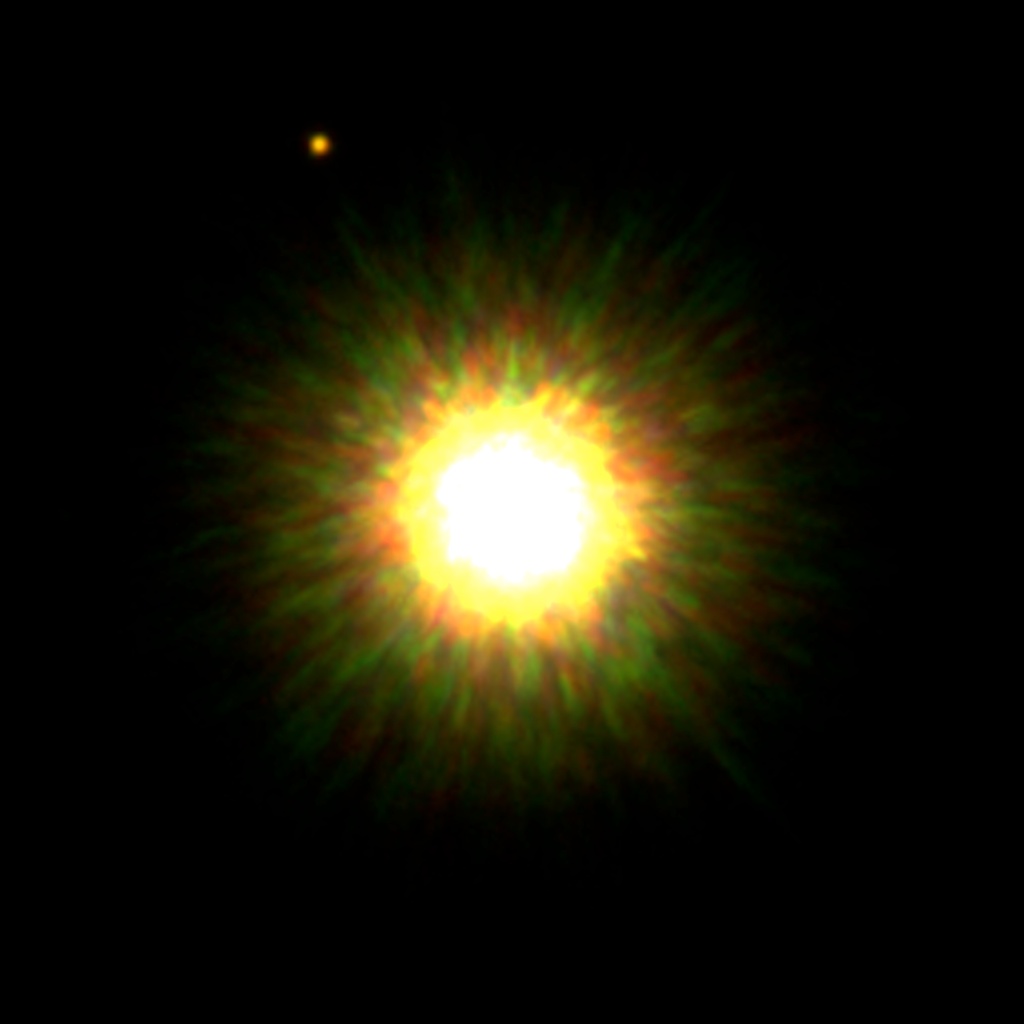 Young Type M star
According to Kiang "Young M stars fry planetary surfaces with ultra-violet flares, so any organisms must be aquatic."
This would be great for underwater colonies along the lines of the movie The Abyss. Although that's not about a colony it is still underwater. Perhaps the colonists don't fully understand about the radiation when first landing, there could be disbelievers about the dangers.
Another idea could be about the star aging and then it is safe for land colonies and people living underwater switch to living on land. Let's not forget all the cool underwater creatures that could exist. Sunblock SPF 200 recommended.
If you'd like to see some artist's rendition of alien plant life check out this slide show for ideas.
The importance of a sun: You cannot have a viable world without it. The planet's orbit around the sun determines how long a year is. For example, keeping it in the solar system, Mars. One Martian year is roughly two Earth years. Someone on Mars will never reach sixty years old without medical intervention, like longevity treatments. Making a year longer or shorter than an Earth year is one major way to make your world more alien.
Did you find this post helpful? Is any of my information incorrect? Thank you for reading.
Monday, May 11, 2009
Summer Session has begun
School is started back up again so it might get a little slow around here, as if it's not slow enough. I'm taking three classes and it's my last semester. Yay! I'm taking Introduction to Social Science, American Short Novels, and Ancient History in Film.
Introduction to Social Science is going to rock because it's all about world building. I couldn't ask for a better class right now. We will be divided up into groups and then we have to create a society on another planet. It's going to be so awesome. I'll keep you updated on how that is going when we really start getting into it next Monday. I couldn't be more excited.
As far as my own world is going I still only have 100/1400 colonist complete. It can be a bit tedious but I'm hoping it will be a little more interesting once I start working on the descendants. I have to come up with a calendar which means I have to start world building. I have decided to put the ships time in synch with the time of the new planet they are going to colonize.
Somethings I have to come up with are:
1. What type of sun?
2. What type of planet?
3. How long does it take for the planet to orbit around the sun?
4. Are there any moons orbiting the planet?
Introduction to Social Science is going to rock because it's all about world building. I couldn't ask for a better class right now. We will be divided up into groups and then we have to create a society on another planet. It's going to be so awesome. I'll keep you updated on how that is going when we really start getting into it next Monday. I couldn't be more excited.
As far as my own world is going I still only have 100/1400 colonist complete. It can be a bit tedious but I'm hoping it will be a little more interesting once I start working on the descendants. I have to come up with a calendar which means I have to start world building. I have decided to put the ships time in synch with the time of the new planet they are going to colonize.
Somethings I have to come up with are:
1. What type of sun?
2. What type of planet?
3. How long does it take for the planet to orbit around the sun?
4. Are there any moons orbiting the planet?
Friday, May 8, 2009
Update on the book search
Before I give results on the book search I just want to say, woohoo! I just reached the 100/1400 mark in my character creation. Now I can switch surnames. I was using American surnames so I think I'm going to use Belgian surnames for the next 100 characters. This way I get a nice mix.
I ended up going to Borders and Barnes and Noble for my book search. Books-A-Million while closer does not have a good selection and when the customer service rep did a search did not seem to have any books in this category in stock. I was able to find The Mysteries of Mithras: The Pagan Belief that Shaped the Christian World by Payam Nabarz Forward by Caitlin Matthews and The Book of gods & goddesses: A Visual Directory of Ancient & Modern Deities by Eric Chaline.
It looks as though the Mithras book is more about neo-paganism rather than a historical account of Mithras worship I could still find it useful as something to extrapolate, I think that's the word, off of. I'll let you know when I finish the book. I guess that would mean a book review. We'll see how well I do with that.
The gods & goddesses book is a basic list book seperated by religion/region and just says what the major gods are of that religion/region. It's basic, simple, and a good jumping off point. I don't think I'll have any of my characters worship any of these gods or goddesses but it's good see characteristics given to them and what the represented and controlled, good things to know when creating your own gods.
I'm also working on a calander system. My fiance said I should base it on the planet they going to colonize that way when they reach it they will already be used to it. It's a good idea and I'll do it that way but I think I'm going to put off world building that until all my characters are completed.
I ended up going to Borders and Barnes and Noble for my book search. Books-A-Million while closer does not have a good selection and when the customer service rep did a search did not seem to have any books in this category in stock. I was able to find The Mysteries of Mithras: The Pagan Belief that Shaped the Christian World by Payam Nabarz Forward by Caitlin Matthews and The Book of gods & goddesses: A Visual Directory of Ancient & Modern Deities by Eric Chaline.
It looks as though the Mithras book is more about neo-paganism rather than a historical account of Mithras worship I could still find it useful as something to extrapolate, I think that's the word, off of. I'll let you know when I finish the book. I guess that would mean a book review. We'll see how well I do with that.
The gods & goddesses book is a basic list book seperated by religion/region and just says what the major gods are of that religion/region. It's basic, simple, and a good jumping off point. I don't think I'll have any of my characters worship any of these gods or goddesses but it's good see characteristics given to them and what the represented and controlled, good things to know when creating your own gods.
I'm also working on a calander system. My fiance said I should base it on the planet they going to colonize that way when they reach it they will already be used to it. It's a good idea and I'll do it that way but I think I'm going to put off world building that until all my characters are completed.
Subscribe to:
Posts (Atom)

 Posts
Posts